MEASURING STRENGTH OF ALCOHOLIC BEVERAGES
Hydrometer Measurement of Alcoholic Beverages
Spirit Measurement Overview
The following article is taken from the Australian Tax Office article, called The alcohol
industry – excise technical guidelines, 2006.
For those small distillers that have no direct contact with a distilling mentor, who knows the industry and ATO policies,
this may be a good starter guide to measuring alcoholic beverages.
For entry and
record keeping purposes, a licensee must measure and record
the correct volume and strength of alcoholic beverages. The
licence holder is required to record the receipt of such goods
from an outside source as soon as practicable after receipt and
details of the goods before each subsequent operation or
movement.
Accurate measurement and recording of alcoholic beverage
quantities and strengths is critical for the correct calculation of
duty liability and for the assessment of any losses sustained
during any stage of production, transit, storage or subsequent
operations. This ensures that a licensee is able to account for all
quantities of such goods.
Subsection 6(2) of the Distillation Act, subsection 3(2) of the
Spirits Act and the preamble to the Schedule to the Excise Tariff
Act state, respectively, that the volume of alcohol contained in
any liquor or other substance, spirits or goods shall be taken to
be the volume that would be the volume of that alcohol if the
alcohol were measured at a temperature of 20°C. Those
provisions also specify that the specific gravity of alcohol in
relation to water is 0.79067. All quantities relating to external
deliveries and receipts are required to be corrected to 20°C to
correctly assess any duty liability in accordance with the Excise
Tariff Act.
Specific gravity of alcohol
The specific gravity of alcohol in relation to water is 0.79067.
However, the table IVa in the International Organisation of Legal Metrology.
The International Alcometric Tables is 0.78924.
Why is this so?
1. Excise Tariff Act (Australia) – 0.79067
This figure is enshrined in Australian law for excise purposes.
It comes from older scientific determinations of ethanol density, going back to the early 20th century, before international harmonisation.
The ATO and Customs use this number as a fixed legal constant, not because it is the best physical value, but because consistency in tax measurement is more important than scientific accuracy.
It means that, for taxation purposes, all calculations are pinned to 0.79067 g/cm³ — even if the “real” physical density differs slightly.
2. OIML Table IVa (International Alcoometric Tables) – 0.78924
This is the modern, internationally recognised value for the density of pure ethanol at 20 °C relative to water at 20 °C.
It’s based on refined experimental data and became standardised through OIML (International Organisation of Legal Metrology).
The OIML tables are widely used for alcoholometry, e.g. in the EU, USA, and international trade.
3. Why the difference?
The difference (0.79067 – 0.78924 ≈ 0.00143) is about 0.18%.
This is due to:
Historical measurement uncertainty (older methods used pycnometry, less precise).
Legal conservatism — once governments lock in a constant for taxation, they rarely change it, because it would cause disputes over past excise and duty assessments.
OIML is a metrological standard, whereas the Excise Act is a legal standard.
4. Implications for you
For excise compliance: you must use 0.79067, even though it is slightly “wrong” physically.
For technical work (winemaking, distillation, scientific calcs): OIML’s 0.78924 is the correct density to use.
This means you may end up keeping two sets of numbers:
One for science/production/export (OIML tables).
One for excise reporting (the Act’s fixed density).
👉 In short: the Excise Tariff Act uses a legally mandated constant, while OIML uses the scientifically correct value.
Bottling of Spirits
These corrected measurements are also required for alcoholic
beverages in the header tank or bottling vat immediately prior to
bottling.
In all other instances of internal movement of alcohol it is not
necessary to correct to standard volumes at 20°C. However in
these instances, ambient temperatures should be recorded.
INSTRUMENTS FOR CALCULATING ALCOHOLIC STRENGTH
3.2 Hydrometers
A hydrometer is an instrument for measuring the density or
specific gravity of a liquid.
A metric hydrometer, or alcoholometer as it is commonly
known, is used for measuring excisable alcoholic beverages.
Alcoholometers are to be used in conjunction with a
thermometer and the Practical Alcohol Tables to convert
indicated strength and indicated temperature to the industry
standard temperature of 20°C.
The use of alcoholometers is described below in.
FROM APPENDIX 11.2
Use of alcoholometer
(section 3.2 in the chapter )
Alcoholometers which comply with Australian Standard
2371/1980 have been approved for the purposes of the
Distillation Act. This standard relates to the glass alcoholometer
(metric hydrometer) used for the determination of alcoholic
strength.
Australian Standard 1006/1995 applies to solid stem general
purpose thermometers which are used in conjunction with
hydrometers.
Prior to each use, the alcoholometer and thermometer should
be inspected to ensure that they are free from damage and are
thoroughly clean and dry.
It is particularly important that the alcoholometer and
thermometer should be thoroughly cleaned after each use. The
alcoholometer and thermometer should be washed in clean
water and dried by gentle wiping with a clean cloth.
Detergents must not be used and the alcoholometer must not
be rubbed vigorously with the cloth, otherwise static electricity
may be generated and affect the accuracy of readings.
A Thorpe’s Still may also be required to extract the alcohol from
the sample being tested where the specific gravity of the sample
is affected by obscuration.
Strength testing steps
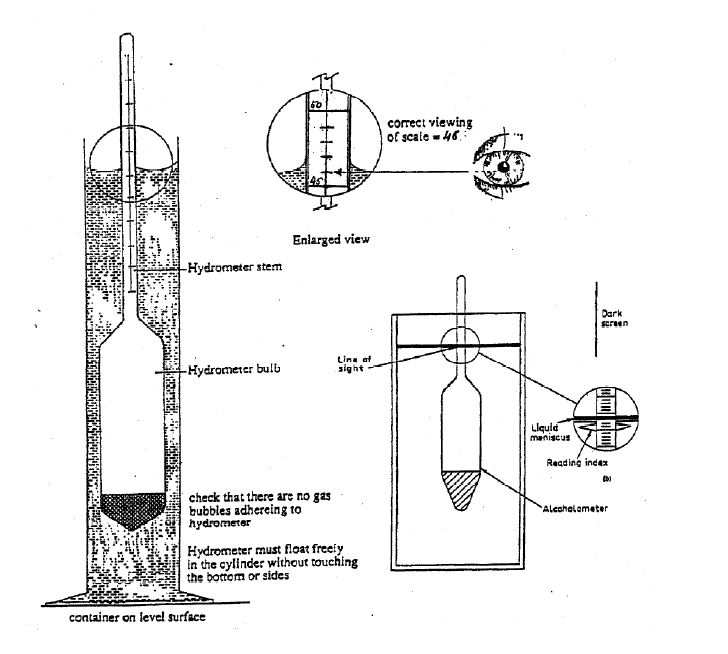
Pour the alcohol sample into a glass hydrometer jar or similar
glass test cylinder. The sample should be poured down the
side of the jar so as to reduce agitation and the formation of
air bubbles.
Stir the sample thoroughly to disperse all bubbles. Do not use
the thermometer to stir the sample.
Select the alcoholometer with the highest % a/v readings.
Gently lower the alcoholometer into the sample until it feels
in equilibrium, and release with a slight spin. The spin is
intended to remove any air bubbles sticking to the side of the
alcoholometer.
Reading alcoholometer and thermometer scales
The reading is where the surface line intersects the
alcoholometer.
Look at the alcoholometer scale from below the surface of the
sample and gradually bring your eye level up to just below the
surface.
When reading an alcoholometer, always read down to the
nearest 0.2% graduation on the scale (that is if you can’t see
the next graduation, read down to the previous value), for
example 37.3% becomes 37.2% and 37.4% stays at 37.4%.
This is the observed strength.
Apply the alcoholometer correction factor (if any). This is the
indicated strength.
Use the thermometer to determine the temperature of the
sample in degrees Celsius (°C). When using a thermometer,
read up to the next 0.5 degrees if the thermometer’s mercury
column exceeds the whole degree or half degree graduation,
for example 20.4°C becomes 20.5°C and 20.0°C remains at
20.0°C. This is the observed temperature.
Apply the thermometer correction factor (if any). This is the
indicated temperature.
Correcting readings to the standard temperature of 20°C
Alcoholometers are calibrated to the standard temperature
of 20°C. You must therefore correct the indicated strength
reading to the standard temperature.
Refer to Volume I, Practical Alcohol Tables. The front section
of the book consists of temperature correction tables.
Ambient temperature is shown across the top of each page
and indicated strength is shown down the left hand side of
each page.
By cross referencing the readings you can arrive at the
apparent strength (sometimes called the corrected
strength) which has been corrected to 20°C.
Adjust for obscuration. Obscuration is the alcohol obscured
or undisclosed by matter such as sugar or colouring in an
alcoholic beverage. Add the obscuration to the apparent
strength to give the actual strength of the sample. The
obscuration figure is normally obtained from the distiller’s
laboratory test results. Obscuration can be determined
independently using a Thorpe’s Still.
3.4 Weights and scales
One method of determining the volume of liquid in a container is
to measure its weight.
The Excise Act requires that a licensed manufacturer shall at
their own expense provide sufficient lights, correct weights and
scales, and all labour necessary for weighing material and
excisable goods received into, manufactured and stored in their
factory.
On receipt of casks, barrels and drums, a licensee is required to
record details of their gross weight in their bond records, hence
the reason for including scales in plant and equipment.
A licensee can use scales for determining the quantities of
alcohol contained in casks, barrels and drums (the procedure
for determining quantity by weight is described at
Appendix 11.4).
If a licensee chooses not to independently weigh casks, barrels
and drums on receipt to verify the volume of alcohol received,
but to accept the supplier’s invoiced quantities without
verification, they will not be given any consideration for transit
losses and will be held accountable for any shortfalls in the
volume of alcohol.
Section 6 in this chapter deals with measuring the contents of
casks, barrels and drums.
Scales are subject to periodic inspection and certification by
State Government authorities under the various States’ Trade
Measurement Acts. It is a legal requirement in every state and
territory that scales used for trade must be certified by an
inspector or authorised licensee. A valid certificate of accuracy
must be held for all scales and weight measuring equipment.
Distillers and manufacturers who receive alcohol in tankers may
also have access to weighbridges. Otherwise volumes delivered
by tanker may be measured by flow meter.
Section 5 in this chapter deals with measuring the contents of
bulk vessels (including vats and tankers).
CALIBRATION OF VESSELS
4.1 Overview
Licensees are required to account for all alcohol and alcoholic
products under their control. They are required to account for:
all excisable product maufactured and all under bond
excisable product received
all excisable product that has been delivered for home
consumption and whether the correct amount of duty has
been paid, and
all excisable product on hand so that excise liability can be
calculated.
Accounting for excisable product starts from the time when
excisable goods are produced:
for fermentable products – from the time fermentation begins
for distilled products – from the time of distillation, and
for received excisable products – from the time of receipt.
In order to meet this requirement, licensees must be able to
accurately measure the quantity of excisable product involved
through the various stages of manufacture and storage.
Historically this has been done by using calibrated tanks.
Tank calibration involves significant cost especially for the micro
market segment of the alcohol industry. When assessing the
degree of accuracy required for a given excise liability the Tax
Office takes into consideration:
the scale of the excise operations involved
practical limitations to calibrating certain vessels, and
alternative methods available.
4.8 Standard drums
For convenience, calibration charts have been produced for
standard 200 litre stainless steel drums and standard 200 litre
plastic drums (Appendix 11.5) and may be used with suitably
calibrated dip sticks.
These charts are to be used only for standard drums. A number
of steel drums contain a poly liner within the steel casing. The
calibration chart is not to be used for those drums.
SECTION 6
MEASURING THE CONTENTS OF CASKS, BARRELS AND DRUMS BY WEIGHT
Casks, barrels and drums are containers that are often irregular
in shape. Therefore, the method used to calculate contents
must be based on weight.
A licensee is required to record the following data:
gross weight of the cask, barrel or drum, using certified scales
(tare weight of the cask, barrel or drum to be deducted to
give net weight of spirit in kilograms), and temperature of the
sample drawn from the vessel, and
alcoholometer indication and apparent strength determined
from Practical Alcohol Tables.
Using the tables in Volume 2, Practical Alcohol Tables, where
applicable the following is required to be determined and
recorded:
strength at 20°C, and
density per litre at 20°C.
Procedures for measuring the contents of casks, barrels and
drums are detailed at Appendix 11.4.
MEASURING THE CONTENTS OF DRUMS BY DIPPING
Drum calibration charts are shown at Appendix 11.5.
Drum calibration charts may be used with suitably calibrated dip
sticks, for calculating the contents of standard 200 litre drums
of spirit if scales are not available for weighing the drums.
This is what I use, as I do not have the area or capacity to have drum scales.
MORE FROM THE ATO
If you have any questions or comments, please send your comments to me via the contact page.
CONTACT US
Try this
Spirit Temperature Correction Calculator