
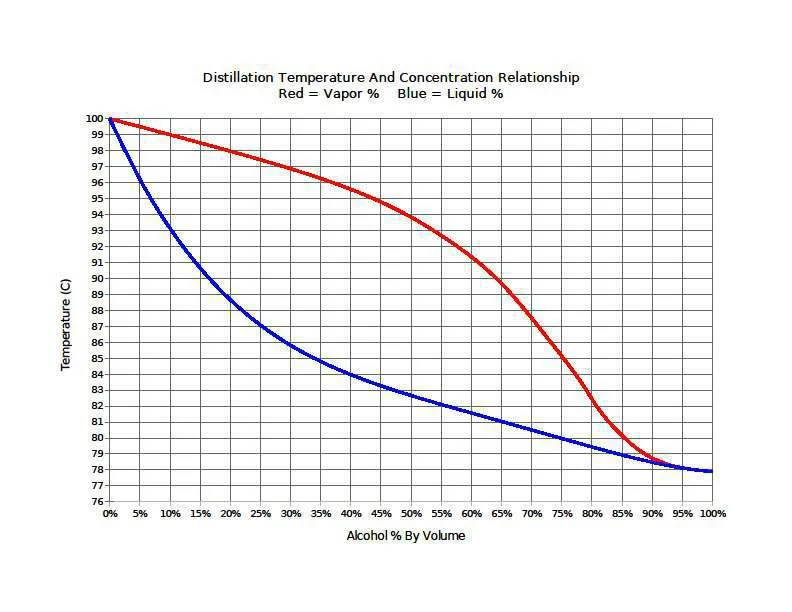
The relationship between vapour temperature and distillate ABV comes from the vapour-liquid equilibrium (VLE) of ethanol-water mixtures. At any given temperature, ethanol and water are present in the vapour above the boiling liquid in a proportion determined by their relative volatilities and the non-ideal molecular interactions.
Ethanol is more volatile than water — it prefers to stay in the vapour phase. This is why a pot still enriches ethanol: the vapour that rises is always richer in alcohol than the liquid boiling below it. As distillation proceeds, the ethanol in the boiler is depleted, the liquid gets more watery, and the vapour temperature rises. This is exactly what your still thermometer tracking measures over a run.
The curve is not linear — the ABV drops slowly at first when temperatures are near the azeotrope (78.15°C / 97.2% ABV), then drops increasingly steeply as the run progresses toward pure water at 100°C.
Water boils at 100°C at standard sea-level pressure, but at lower temperatures at altitude because atmospheric pressure drops and the pressure in your still drops. The same applies to ethanol-water mixtures, the entire tracking curve shifts downward as altitude increases.
If you use a static sea-level table at altitude, every thermometer reading will be off by 2–4°C — which translates to a significant 5–15% ABV calculation error. This calculator handles that offset step dynamically.

If you want to know how much alcohol percentage is in your collection jar at room temperature conditions, look up our dedicated Spirit Temperature Correction Calculator to adjust the direct hydrometer measurement readings.
Try this out here: Spirit Temperature Correction Calculator
| Vapour Temp (°C) | Vapour Temp (°F) | Distillate ABV | US Proof |
|---|

 SHOP
SHOP